
This article looks at how the introduction of UAD 3.6 will impact Appraisal Management Companies (AMCs), and outlines considerations for lenders who want to complete a hybrid appraisal with AMCs.
AMC Benefits and Company Valuation
AMCs are the trusted valuation providers for most lenders in the U.S. mortgage industry. Lenders rely on AMCs for (traditional) appraisal management and also to provide alternative valuations for servicing and non-agency lending programs. AMCs largely outsource an internal function that would otherwise be an operational expense for lenders, and provide a compliance layer to meet the Appraisal Independence Requirements (AIR), investor guidelines and other regulations.
Aside from any technology that may have been developed, when AMCs are valued and acquired the principal value is derived from the customer base, key employees and some multiple of EBITDA.
The introduction of UAD 3.6
The UAD 3.6 data standard increases digitization of the appraisal process to enable better risk management by the GSEs and other industry participants. UAD 3.6 modernizes the URAR traditional appraisal but is also the data schema that supports Uniform Property Data (UPD) Reports, Hybrid Appraisals (1004 Hybrid/70H) and Desktop Appraisals (1004 Desktop/70D), and serves as a platform for more innovation in appraisal management.
Lender Expectations for AMCs (and internal Appraisal Fulfillment)
For lenders, the '30-days close' remains the gold standard, and any appraisal order that extends beyond 2 weeks, especially if that is originally quoted as a delivery date, is going to be tracked carefully. Despite the exceptions often quoted today, the average national traditional appraisal turn time of 7.7 business days.
As the monthly Freddie Mac appraiser capacity report shows, the number of appraisers actively supporting the residential mortgage is at an all time low - down 25% in 5 years to ~30,000. Any rate changes that increase the refinance incentive will quickly impact traditional appraisal turn times.
What do lenders expect from their AMC providers?
(And internal Appraisal Fulfillment Operations)
They expect the same as any company who outsources a critical business function to a vendor: Reliable performance that meets and exceeds industry norms, and proactive problem solving when issues arise.
If an AMC is not yet prepared to offer and support all of the modernization solutions that the GSEs offer in their selling guides, then lenders should select one of their other AMCs to pilot the new programs.
It is much harder for providers to gain market share with a lender in a new valuations program when there is established AMC(s) already providing these services.
Hybrid Appraisal with AMCs (and the impact on AMC company valuation)
Hybrid appraisals require between 30-70% less appraisers to complete assignments than traditional appraisals, depending on the state and county. Appraisers have been completing (proprietary) hybrid and desktop appraisals for 2 decades, so there are appraisers ready and willing to complete these assignments.
Checklist for AMCs
- Identify and engage appraisers who want to complete hybrid appraisal assignments
- Business relationship - rank the total volume, net fees, turn times and distance traveled for appraisers
- Performance - rank the quality, timeliness, and revision rate of these appraisers
- Compliance & disciplinary actions - check the appraiser is not on ‘Do Not Use’ and exclusionary lists
- Business plan - build a forecast of order volume and the fees you anticipate paying these appraisers
- Engage a UPD provider that has a successful track record in delivering for GSEs, lenders and AMCs
- 3D scan so appraisers can 'walk the property'
- Nationwide network of property data collectors
- Prefilled UAD 3.6 URAR, and TOTAL Zap file to eliminate re-keying for appraisers
Why Asteroom?
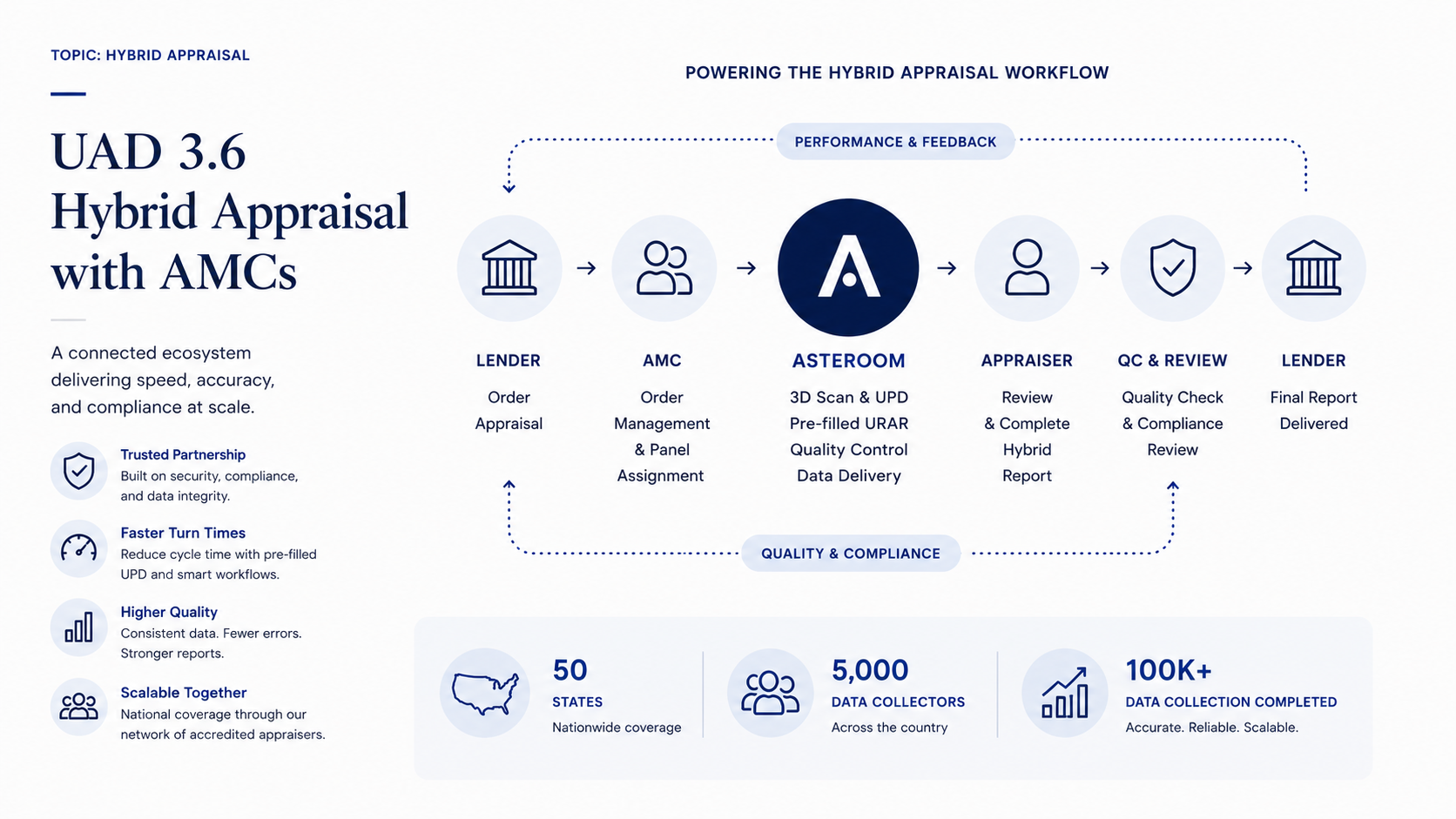
Key differentiators for Asteroom include the 3D scan, prefilled URAR and a nationwide network of data collectors.
Proprietary 3D Property Scan
Asteroom has developed proprietary 3D property scanning technology. An Asteroom scan captures the full UPD with a ‘once-through-the-property’ inspection so appraisers can 'walk the property' rather than relying on static photos, form-filled data entry of 1st generation providers. The UPD comprises:
- A 3D scan virtual walkthrough, with room-to-room spatial validation
- ANSI-aligned floor plans with internal measurements and layout verification
- Required data collection and photo images
- Prefilled UAD 3.6 URAR, and TOTAL Zap file
This creates a more complete property dataset for the appraiser while improving transparency and simplifying reviews for lenders, QC teams, and secondary market participants.
For non-agency markets and use-cases, Asteroom provides additional inspection elements like damage identification & measurement, equipment and appliance identification, definition of materials and finishes, verification of utilities, and other custom requirements.
Nationwide Network
Asteroom operates a nationwide network of data collectors, managing all aspects of borrower communication, UPD scheduling, on-site inspection, QC, GSE API submission, and report delivery.
Asteroom supports 450+ lenders, 90+ banks and 80+ AMCs and are approved integrated technology & service providers for Fannie Mae and Freddie Mac.