
As hybrid appraisals continue expanding, lenders and AMCs are increasingly focused on one issue: the quality, consistency and subsequent verification of the underlying property dataset delivered to the appraiser.
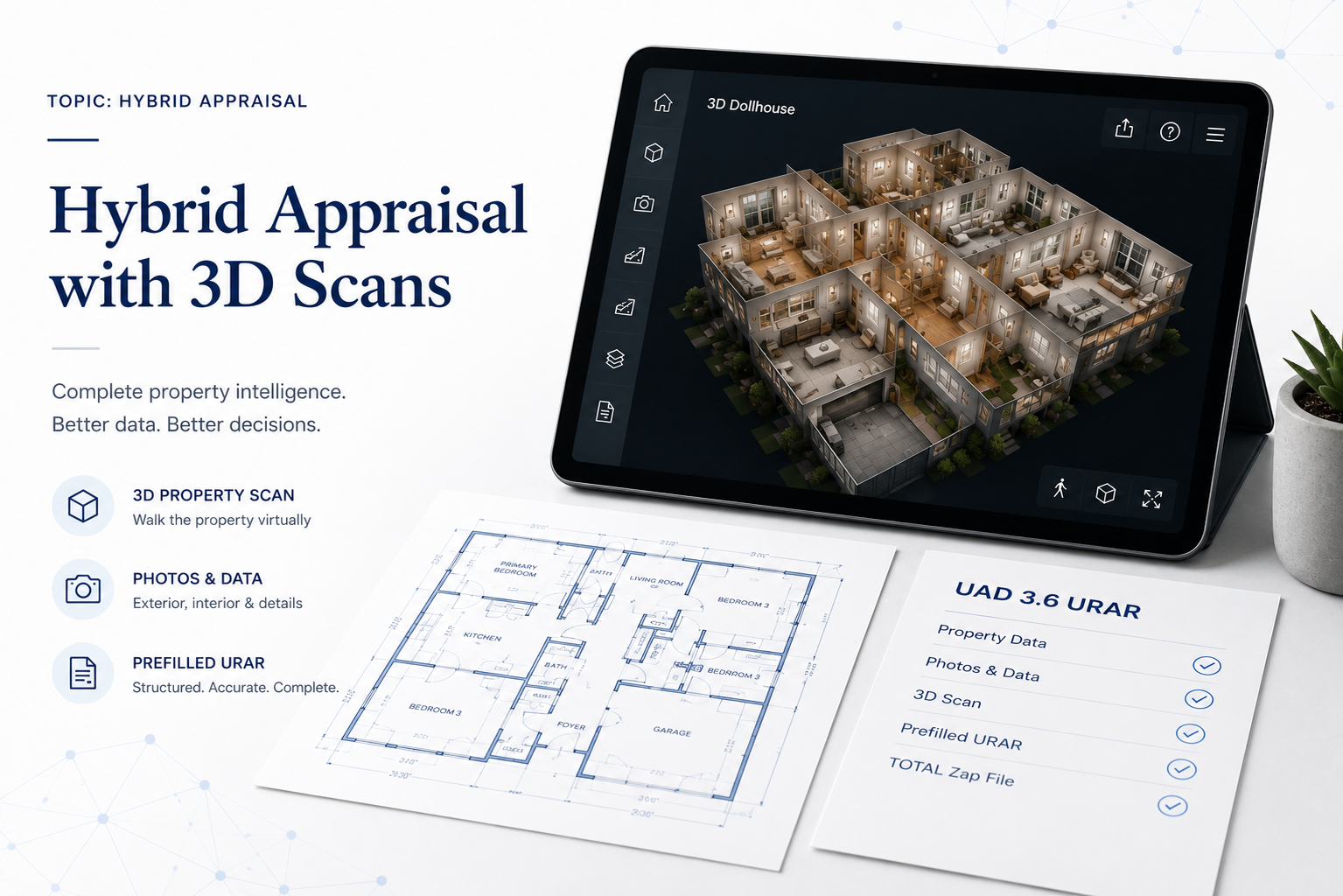
Other hybrid inspection providers deliver static photos, form-based Q&A inspection reports with basic condition commentary. Asteroom takes a very different, data-centric approach built around proprietary 3D scanning, layered quality control, and direct appraisal workflow integration.
3D Property Scanning vs. Traditional Photo Collection
A primary differentiator for Asteroom is its proprietary 3D property scanning technology.
An Asteroom scan captures the full UPD with a ‘once-through-the-property’ inspection. Rather than relying solely on static photos, form-filled data entry, the platform creates:
- A 3D scan virtual walkthrough, with room-to-room spatial validation
- ANSI-aligned floor plans with internal measurements and layout verification
- Required data collection and photo images
- Prefilled UAD 3.6 URAR, and TOTAL Zap file
For non-agency markets and use-cases, Asteroom provides additional inspection elements like damage identification & measurement, equipment and appliance identification, definition of materials and finishes, verification of utilities, and other custom requirements.
Multi-Layer Quality Control
Asteroom also differentiates itself through multiple levels of quality control that results in (a) over 98% quality scores from major investors, and (b) revision rates less than x% across all orders. This is possible because Asteroom uses virtual quality assistants to:
- Perform onsite guidance and QC during the inspection process
- Independent floor plan QC and validation
- Full overnight QC review to validate UPD inputs from the observed 3D walkthrough
This layered process helps identify missing photos, incomplete room coverage, measurement inconsistencies, data gaps, and property characteristic discrepancies
Many hybrid workflows still rely heavily on manual photo review after delivery, creating higher revision rates and longer turn times.
Pre-populated Appraisal Workflows and 3D Walkthrough
Asteroom has introduced a series of features to enable appraisers to complete UAD 3.6 hybrid appraisals faster and with more confidence.
- The 3D walkthrough enables appraisers to complete a virtual visit to the subject property and site. Any inconsistencies or clarifications can be resolved at the desktop by the appraiser as they complete the report.
- Lenders, underwriters, investors and third-party review firms also use 3D walkthroughs on occasion to reconcile report discrepancies and disputes
- Prepopulation of the UAD 3.6 appraisal directly from UPD is now available for Cotality TOTAL users, significantly reducing the time to complete appraisals.
Rather than requiring appraisers to manually re-enter inspection data, Asteroom supports prepopulation of property characteristics, room-level details, condition observations, floor plan data, and photos and exhibits. This can reduce administrative workload while improving consistency between the inspection dataset and the final appraisal report.
UAD 3.6 Hybrid Appraisal Checklist
To assist lenders as they prepare for the UAD 3.6 mandate in November, Asteroom offers this checklist to evaluate UPD vendor capabilities to support appraisers, borrowers and underwriters.
|
Capability |
Asteroom |
Hybrid Competitors |
|
Proprietary 3D Scan |
✓ |
Limited |
|
ANSI Floor Plans |
✓ |
Partial |
|
Onsite QC |
✓ |
Varies |
|
Overnight QC Review |
✓ |
Limited |
|
Floor Plan QC |
✓ |
Limited |
|
Virtual Tour for Marketing |
✓ |
Rare |
|
URAR Pre-filled with UPD report data |
✓ |
Limited |
|
Structured Property Dataset |
✓ |
Partial |
As UAD 3.6 adoption expands, hybrid appraisal providers are increasingly being evaluated on the quality, completeness, and usability of the property dataset — not simply the ability to collect photos. Asteroom is positioned around creating a structured digital property record designed to support both current hybrid appraisal workflows and future collateral data requirements.